
Ohm’s Law: The Simple Formula That Controls All Electricity
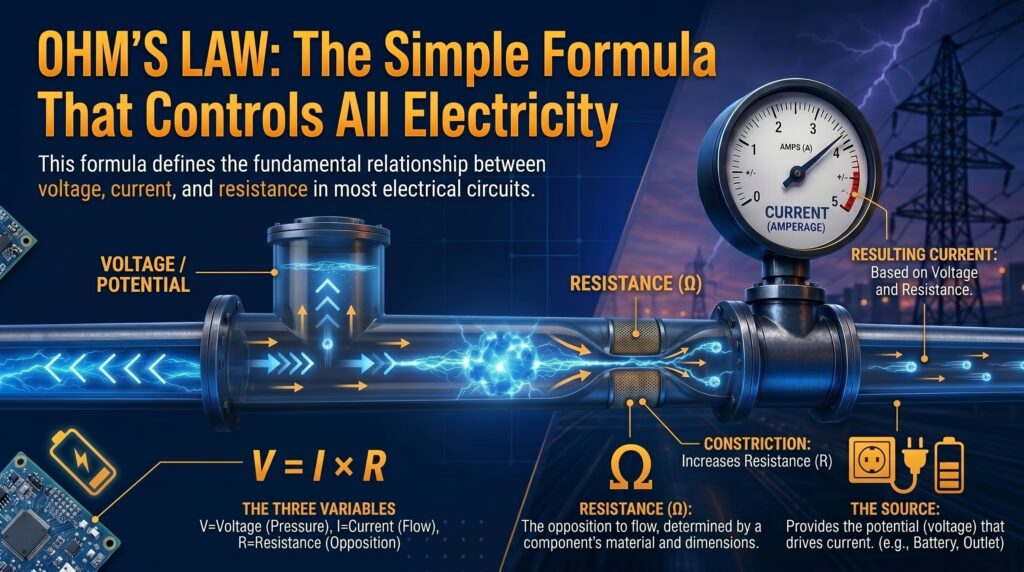
Every electrical device you use — from a tiny phone charger to a massive air conditioner — follows one simple rule called Ohm’s Law.
It sounds complicated, but it is actually one of the easiest concepts in electricity. In fact, if you already understand Voltage, Current, and Resistance, then you already understand most of Ohm’s Law.
The law simply explains how these three forces work together.
The Basic Idea
Imagine again that electricity is water flowing through a garden hose.
- Voltage is the pressure pushing the water.
- Current is the amount of water flowing.
- Resistance is anything squeezing the hose and slowing the flow.
Ohm’s Law tells us exactly how changing one of these affects the others.
The formula is:V=IR
Where:
- V = Voltage (Volts)
- I = Current (Amps)
- R = Resistance (Ohms)
This tiny equation controls almost every electrical circuit on Earth.
What the Formula Really Means
More Voltage = More Current
If you increase the electrical pressure, more electricity flows through the wire.
Think about turning the faucet on harder. More pressure pushes more water through the hose.
In electricity:
- Higher Voltage → Higher Current
More Resistance = Less Current
Now imagine stepping on the hose.
Even if the faucet pressure stays the same, less water gets through because the path is restricted.
In electricity:
- Higher Resistance → Lower Current
That is why thin wires heat up more easily than thick wires — they resist electricity more.
A Real-Life Example
Imagine a simple flashlight.
The battery provides:
- 9 volts
- The bulb creates:
- 3 ohms of resistance
Using Ohm’s Law:
I=RV=39=3
The current flowing through the flashlight is 3 amps.
That means the battery pressure is strong enough to push 3 amps of electricity through the bulb.
Why This Matters
Ohm’s Law is not just a classroom formula. Electricians, engineers, and technicians use it every day to:
- Design safe circuits
- Prevent overheating
- Choose correct wire sizes
- Build chargers and power supplies
- Calculate battery usage
Without Ohm’s Law, modern electronics simply would not work safely.
The Easy Way to Remember It
Think of it like this:
- Voltage pushes
- Resistance fights
- Current flows
Or in water terms:
- Pressure pushes water
- A narrow pipe slows it down
- The moving water is the flow
And that is Ohm’s Law — the tiny equation quietly controlling every electronic device around you.