The Anatomy of a Home Electrical Panel: What Do Your Breakers Actually Do?
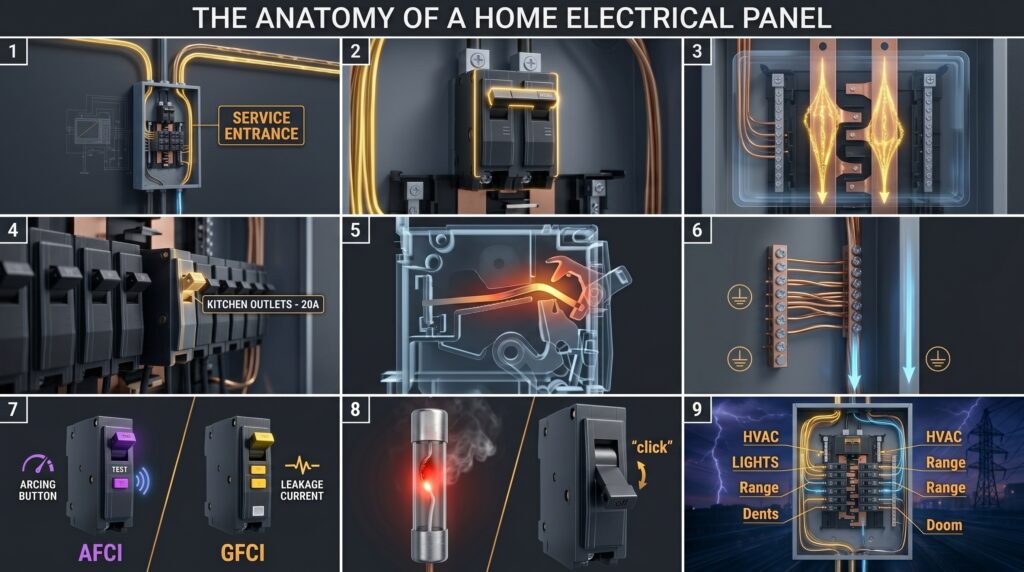
The Anatomy of a Home Electrical Panel: What Do Your Breakers Actually Do? When you flip a light switch, charge your phone, or run your air conditioner, electricity travels through a complex network inside your home. At the center of that network is one of the most important yet overlooked components of your electrical system: the electrical panel. Most homeowners only notice the electrical panel when a breaker trips and the power suddenly goes out. But what exactly is happening inside that gray metal box on the wall? And what do all those breakers actually do? In this guide, we’ll break down the anatomy of a home electrical panel in simple terms so you can better understand how your home’s electrical system works. What Is an Electrical Panel? An electrical panel, sometimes called a breaker panel, service panel, or distribution board, is the central hub that distributes electricity throughout your home. Think of it like the main train station for electricity: Without an electrical panel, electricity couldn’t be safely controlled or distributed throughout your house. A Quick Look Inside the Panel When you open the panel door, you’ll typically see: Each component has a specific job that helps keep your electrical system running safely. 1. The Main Breaker: The Master Switch The largest breaker at the top of the panel is usually the main breaker. What It Does The main breaker controls power for the entire house. If you switch it OFF: Typical Ratings Most modern homes have: The number indicates the maximum amount of electrical current your home can safely use at one time. Why It Matters The main breaker acts as your home’s first line of protection against major electrical overloads. 2. Circuit Breakers: The Guardians of Each Circuit The smaller switches lined up inside the panel are called circuit breakers. These are the components homeowners interact with most often. What Does a Breaker Do? A breaker constantly monitors electrical current flowing through a circuit. If the circuit draws too much current: Think of a breaker as a security guard that immediately shuts things down when conditions become unsafe. Why Do Breakers Trip?A breaker usually trips for one of three reasons: 1. Overload Too many devices are connected to the same circuit. Example: Running simultaneously may exceed the circuit’s capacity. 2. Short Circuit A hot wire accidentally touches another conductor. This causes: The breaker trips almost instantly. 3. Ground FaultElectricity finds an unintended path to the ground. This can happen when: Ground faults can be dangerous and require immediate protection. 3. Single-Pole vs. Double-Pole Breakers Not all breakers are the same. Single-Pole Breakers These are the most common breakers. They typically power: Most are rated for: They operate on 120 volts. Double-Pole Breakers These breakers occupy two spaces in the panel. They typically power: Most operate on 240 volts and provide more power for large appliances. 4. GFCI Breakers: Protection Around Water Ground Fault Circuit Interrupter (GFCI) breakers are designed to prevent electric shock. Common Locations You’ll often find GFCI protection in: How They Work A GFCI constantly compares outgoing and returning current. If even a tiny amount of electricity leaks somewhere it shouldn’t: This happens fast enough to greatly reduce the risk of serious injury. 5. AFCI Breakers: Fire Prevention Technology Arc Fault Circuit Interrupter (AFCI) breakers protect against electrical fires. What Is an Arc Fault? An arc occurs when electricity jumps through air because of: These arcs can generate extreme heat and ignite nearby materials. What AFCI Breakers Do They detect unusual arcing patterns and shut off power before a fire can start. Modern building codes often require AFCI protection in many living areas. 6. Bus Bars: The Hidden Power Highways Behind the breakers are metal strips called bus bars. Their Purpose Bus bars distribute electricity from the main breaker to all branch circuits. You rarely see them because breakers snap directly onto them. Think of bus bars as the main highways carrying electricity through the panel. 7. Neutral and Ground Bars Two important metal bars inside the panel help complete electrical safety systems. Neutral Bar The neutral bar: Ground Bar The ground bar: Together, these components help ensure electricity flows safely and predictably. Understanding Breaker Labels A properly labeled panel makes troubleshooting much easier. Common labels include: If your panel labels are missing or unclear, consider updating them. It can save significant time during repairs or emergencies.
Ohm’s Law: The Simple Formula That Controls All Electricity
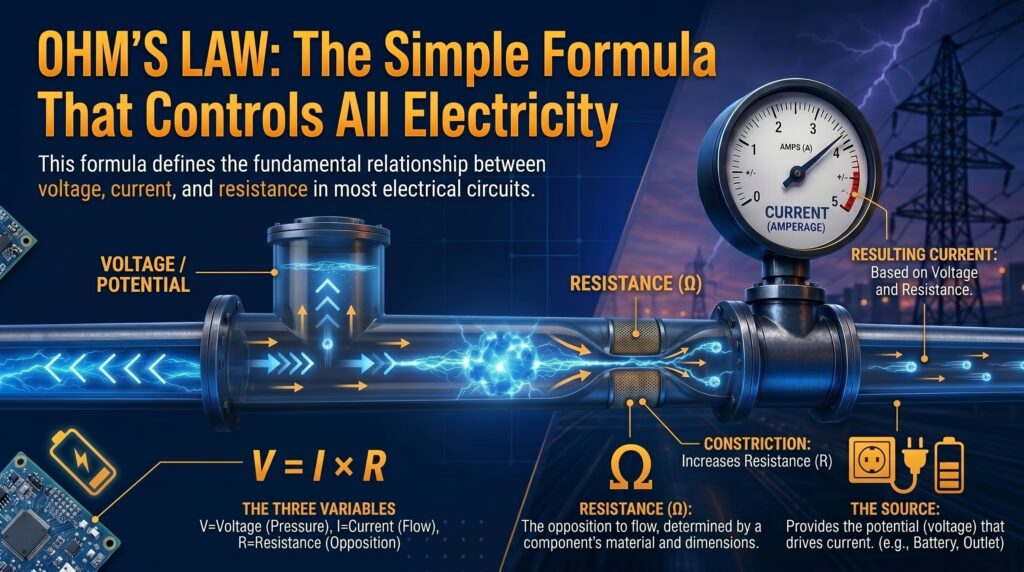
Ohm’s Law: The Simple Formula That Controls All Electricity Every electrical device you use — from a tiny phone charger to a massive air conditioner — follows one simple rule called Ohm’s Law. It sounds complicated, but it is actually one of the easiest concepts in electricity. In fact, if you already understand Voltage, Current, and Resistance, then you already understand most of Ohm’s Law. The law simply explains how these three forces work together. The Basic Idea Imagine again that electricity is water flowing through a garden hose. Ohm’s Law tells us exactly how changing one of these affects the others. The formula is:V=IRV = I RV=IR Where: This tiny equation controls almost every electrical circuit on Earth. What the Formula Really Means More Voltage = More Current If you increase the electrical pressure, more electricity flows through the wire. Think about turning the faucet on harder. More pressure pushes more water through the hose. In electricity: More Resistance = Less Current Now imagine stepping on the hose. Even if the faucet pressure stays the same, less water gets through because the path is restricted. In electricity: That is why thin wires heat up more easily than thick wires — they resist electricity more. A Real-Life Example Imagine a simple flashlight. The battery provides: Using Ohm’s Law: I=VR=93=3I = \frac{V}{R} = \frac{9}{3} = 3I=RV=39=3 The current flowing through the flashlight is 3 amps. That means the battery pressure is strong enough to push 3 amps of electricity through the bulb. Why This Matters Ohm’s Law is not just a classroom formula. Electricians, engineers, and technicians use it every day to: Without Ohm’s Law, modern electronics simply would not work safely. The Easy Way to Remember It Think of it like this: Or in water terms: And that is Ohm’s Law — the tiny equation quietly controlling every electronic device around you.