Ohm’s Law: The Simple Formula That Controls All Electricity
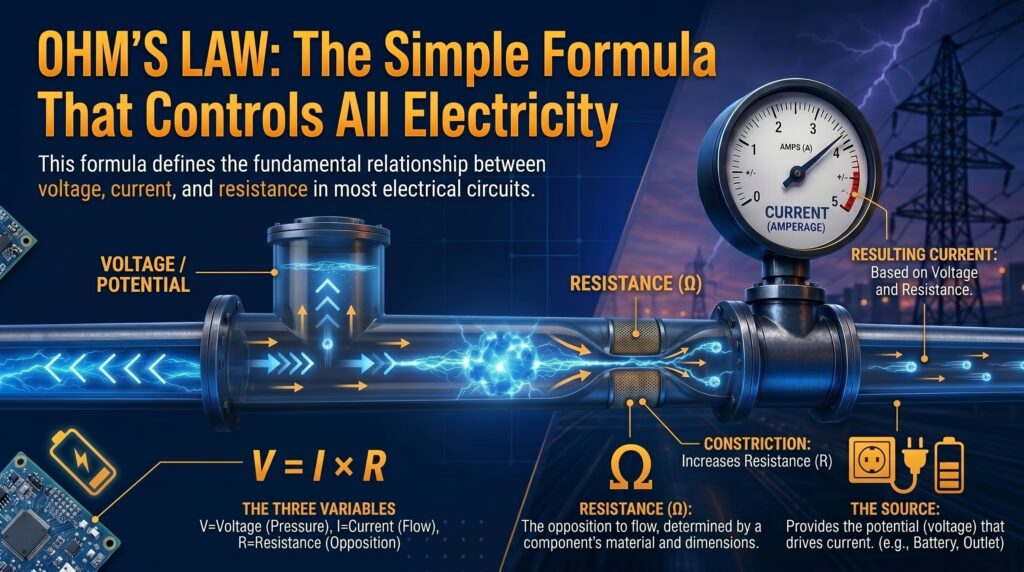
Ohm’s Law: The Simple Formula That Controls All Electricity Every electrical device you use — from a tiny phone charger to a massive air conditioner — follows one simple rule called Ohm’s Law. It sounds complicated, but it is actually one of the easiest concepts in electricity. In fact, if you already understand Voltage, Current, and Resistance, then you already understand most of Ohm’s Law. The law simply explains how these three forces work together. The Basic Idea Imagine again that electricity is water flowing through a garden hose. Ohm’s Law tells us exactly how changing one of these affects the others. The formula is:V=IRV = I RV=IR Where: This tiny equation controls almost every electrical circuit on Earth. What the Formula Really Means More Voltage = More Current If you increase the electrical pressure, more electricity flows through the wire. Think about turning the faucet on harder. More pressure pushes more water through the hose. In electricity: More Resistance = Less Current Now imagine stepping on the hose. Even if the faucet pressure stays the same, less water gets through because the path is restricted. In electricity: That is why thin wires heat up more easily than thick wires — they resist electricity more. A Real-Life Example Imagine a simple flashlight. The battery provides: Using Ohm’s Law: I=VR=93=3I = \frac{V}{R} = \frac{9}{3} = 3I=RV=39=3 The current flowing through the flashlight is 3 amps. That means the battery pressure is strong enough to push 3 amps of electricity through the bulb. Why This Matters Ohm’s Law is not just a classroom formula. Electricians, engineers, and technicians use it every day to: Without Ohm’s Law, modern electronics simply would not work safely. The Easy Way to Remember It Think of it like this: Or in water terms: And that is Ohm’s Law — the tiny equation quietly controlling every electronic device around you.
ACvsDC: What Is the Difference and Why Does Your Home Use Both?
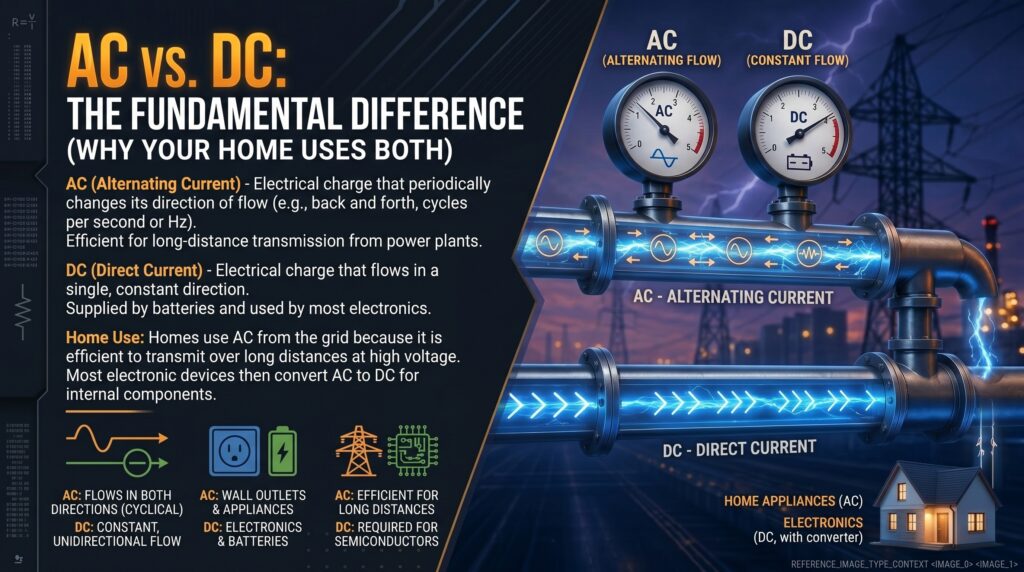
AC vs. DC: What Is the Difference and Why Does Your Home Use Both? If you look around your room right now, you are surrounded by two completely different types of electricity: AC (Alternating Current) and DC (Direct Current). They don’t get along, they work entirely differently, yet your modern life completely depends on both of them. What is the difference, and why haven’t we just picked one? Direct Current (DC): The Steady March Direct Current is electricity that flows in one single direction, like a one-way street. It leaves a power source, travels down the wire, and never turns back. Alternating Current (AC): The Tug-of-War Alternating Current does not like staying still. Instead of flowing in a straight line, it constantly changes direction—shuffling backward and forward, up to 50 or 60 times every single second! Why Your Home Needs Both If DC powers our gadgets and AC powers our walls, why the split personality? Why can’t we just use one for everything? It comes down to a historic battle of strengths. Why we use AC for the Grid: Electricity loses power as it travels over long distances. Millions of volts of AC can be pushed across hundreds of miles through thin cables without losing much energy. When it reaches your neighborhood, a transformer easily “steps down” that massive pressure into a safe voltage for your house. DC cannot travel long distances easily without losing massive amounts of power. Why we use DC for Electronics: Microchips, LED screens, and batteries require smooth, predictable, and gentle energy. If you fed the chaotic, back-and-forth shuffling of AC power directly into your phone’s processor, it would instantly fry the electronics. The Peacekeeper: Your Charging Brick Have you ever wondered why your laptop cable or phone charger has a bulky plastic box attached to it? That box is a converter. It takes the rough, back-and-forth AC power from your wall outlet and tames it, converting it into smooth, one-way DC power that your device’s battery can safely digest. So, next time you plug in your phone, you are witnessing a perfect partnership: AC brings the power all the way to your house, and DC quietly runs the device in your hand!
Voltage, Current, and Resistance Explained with Simple Analogies
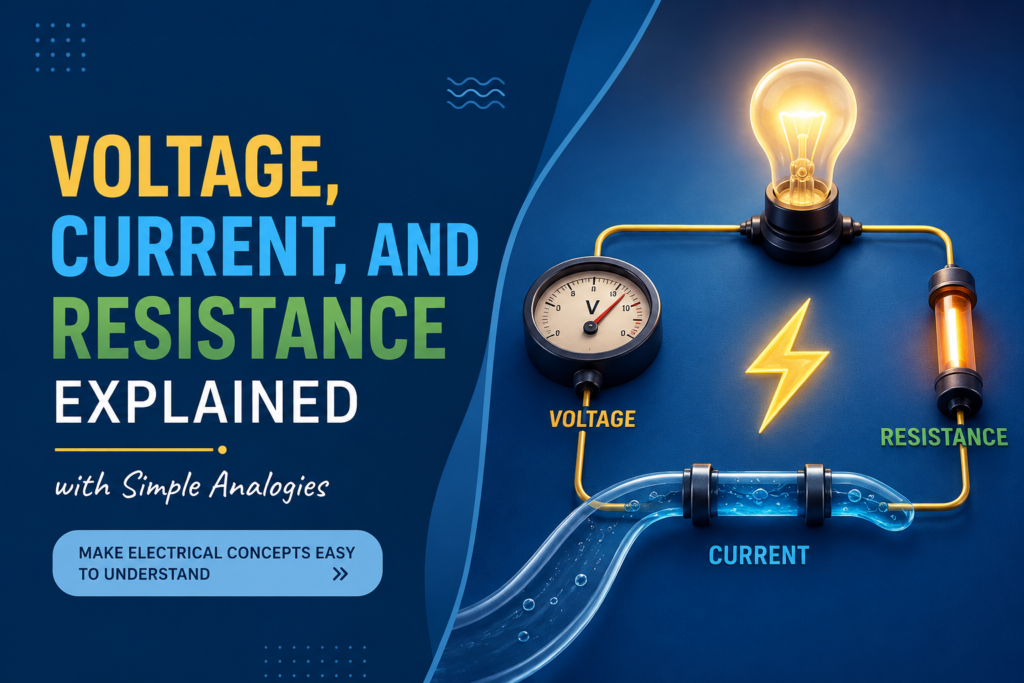
Voltage, Current, and Resistance Explained with Simple Analogies Smart Electrical AI Have you ever looked at a wall outlet and wondered how electricity actually works? Phrases like “volts,” “amps,” and “ohms” get thrown around all the time, but what do they actually mean to a normal person? To understand electricity, we don’t need a degree in engineering. We just need to imagine a garden hose hooked up to a faucet. Let’s break down the three invisible forces that power our world using this simple water analogy. Voltage (The Pressure) Imagine your garden hose. If the faucet is turned off, the water just sits there. But when you turn the faucet on, pressure pushes the water through the hose. In the electrical world, Voltage is that pressure. It is the force that pushes electrical energy through a wire. Current (The Flow) Now, look at the actual water moving through the hose. If you have a wide hose, a large volume of water flows out every second. If it’s a thin straw, only a trickle comes out. The actual flow of electricity is called Current. It is the physical amount of electrical charge moving through the wire. Resistance (The Restriction) What happens if you step on the garden hose? You squeeze it, making it harder for the water to get through. The water slows down, and less comes out the other end. In a wire, this squeezing effect is called Resistance. It is how much a material fights against the flow of electricity. Putting It All Together Think of it as a team effort: When you plug in a smartphone charger, the voltage from the wall pushes a safe amount of current through the wire, because the charger’s internal components provide just the right amount of resistance to keep things from overheating. And that is electricity in a nutshell!
A Beginner’s Guide to Smart Electrical Systems

Smart Electrical AI A Beginner’s Guide to Smart Electrical Systems Everything you need to know to get started — without the jargon overload By Smart Electrical AI | smartelectricalai.com Hey there, fellow engineers! Whether you’ve been in the field for years or just getting started, you’ve probably noticed that the electrical industry is changing fast. Smart systems, AI-driven automation, and intelligent grid technologies are no longer just buzzwords — they’re becoming the new normal. In this post, we’re going to break down what smart electrical systems actually are, how they differ from traditional setups, and why every electrical professional should care. Let’s get into it! “The future of electrical engineering isn’t just about wires and circuits — it’s about intelligence, connectivity, and automation working together.” So, What Exactly Is a Smart Electrical System? A smart electrical system is any electrical infrastructure that uses digital communication, sensors, and intelligent control to monitor, manage, and optimize electrical power flow — automatically and in real time. Think of it as the difference between a traditional light switch and a smart switch that learns your schedule, adjusts based on occupancy, and reports energy usage to your phone. Now scale that idea up to an entire building, factory, or power grid, and you’ve got a smart electrical system. Key Components You’ll Encounter As a professional, here are the core building blocks you’ll be working with: Traditional vs. Smart Systems — The Real Differences Here’s a quick mental model to compare the two approaches side by side: Where Does AI Fit In? This is where things get really exciting — and it’s exactly what our channel is all about. Artificial Intelligence adds a powerful layer on top of smart electrical infrastructure: AI doesn’t replace the electrical engineer — it gives you a superpower: the ability to see, predict, and respond to system behavior faster and smarter than ever before. Why Should Electrical Professionals Care Right Now? You might be thinking — ‘I’ve been doing great without this stuff for years.’ Fair point! But here’s the reality: What’s Next? This is just the beginning! In upcoming posts and videos on the Smart Electrical AI YouTube channel, we’ll be diving deeper into topics like: Whether you’re looking to upskill, stay relevant, or just satisfy your curiosity — you’re in the right place. Subscribe to the channel, bookmark the website, and let’s learn together. Have questions or topics you’d like covered? Drop them in the comments below! smartelectricalai.com | YouTube: Smart Electrical AI